
SEO has been written off as dead almost as long as it’s even existed.
Every new Google update, change to a social platform and new AI tool seems to bring another bunch of predictions about the end of traditional search being just around the corner. In 2026, those predictions feel pretty convincing. Google is now answering loads of questions straight from its results pages, people are using AI helpers to do their product and service research, and search journeys are getting longer and more like a conversation between two people.
But the harsh truth is – its not that dramatic.
SEO has definitely changed, but this isn’t nothing new. SEO has been changing consistently over the past 20 years. Businesses still need decent websites, clear information and a strong online reputation. What’s changed is how and where that information is actually found.
So which bits of SEO are actually different in 2026, and which old principles still count?
What’s changed in 2026 for SEO?
Search results are created from the type of answer you’re looking for
For a lot of searches, Google’s not just slapping up a list of ten links anymore.
The AI Overviews and other generative search features can quickly sum up loads of different sources, answer follow-up questions and help users explore a subject without them ever having to leave the search results page. And the good news is that these new features don’t actually require any new or special kind of SEO. Websites still need to have clear information, that people will actually find helpful and that they can trust.
For businesses, this means that ranking in an old-fashioned organic position isn’t the only way to measure visibility anymore. Your content could also get quoted, referenced or used as a source in an AI-generated response.
Search queries are getting a lot more conversational
People are getting more and more comfortable asking longer, more in-depth questions.
Instead of searching for “accountant Basingstoke”, somebody might ask: “What type of accountant should a growing Basingstoke business use if it wants to get some help with cash flow and tax planning?”
This makes it even more important to get a feel for what the real question behind a keyword is. A page shouldn’t just repeat the search phrase back at the user. It should help them get a better understanding of the subject and make a decision.
Keyword research is still worth doing, but it needs to be combined with a genuine understanding of what your customers are actually looking for.
You can’t assume visibility will always produce a click
Search results are now featuring AI-generated answers, featured snippets, maps, videos and all sorts of other extras that can give users all the information they need before they even need to visit a website.
This has led to the zero-click search, which has resulted in reducing the number of visits to informational pages – although the impact varies a lot depending on what kind of question and what kind of content you’re dealing with.
Previously there has been heavy reliance on website traffic increasing to evaluate the success of a SEO campaign. The focus may no longer be just on traffic and successful SEO in the AI era will use other engagement metrics as the measurement. These metrics may previously have been a secondary focus but are now at the forefront:
- Qualified enquiries
- Phone calls
- People searching for your brand
- Activity on your Google Business Profile
- Sales and conversions
- Visibility for searches that are actually relevant to your business
- How often people are mentioning your business in their results
One hundred visits from people who are actually looking for your service is worth a lot more than one thousand visits from people who were never going to be interested in the first place.
Rubbish content is easier to churn out – and easier to ignore
AI has made it possible to create lots of content quickly. But being able to produce more content doesn’t actually mean that content is any good. Pages that just reword information that’s already out there give search engines and potential customers no real reason to choose one business over another.
Google still says that content made to help people, rather than just to manipulate rankings is best. It encourages businesses to try and do something new and original, to offer genuine expertise and a good experience.
Good content is likely to include things that can’t be easily copied, like:
- First-hand experience
- Original examples
- Customer questions
- Expert opinions
- Local knowledge
- Case studies
- Proprietary research or data
- Clear opinions backed up with evidence
AI can help with research, structure and editing – but it can’t replace genuine knowledge of your customers, your services and your industry.
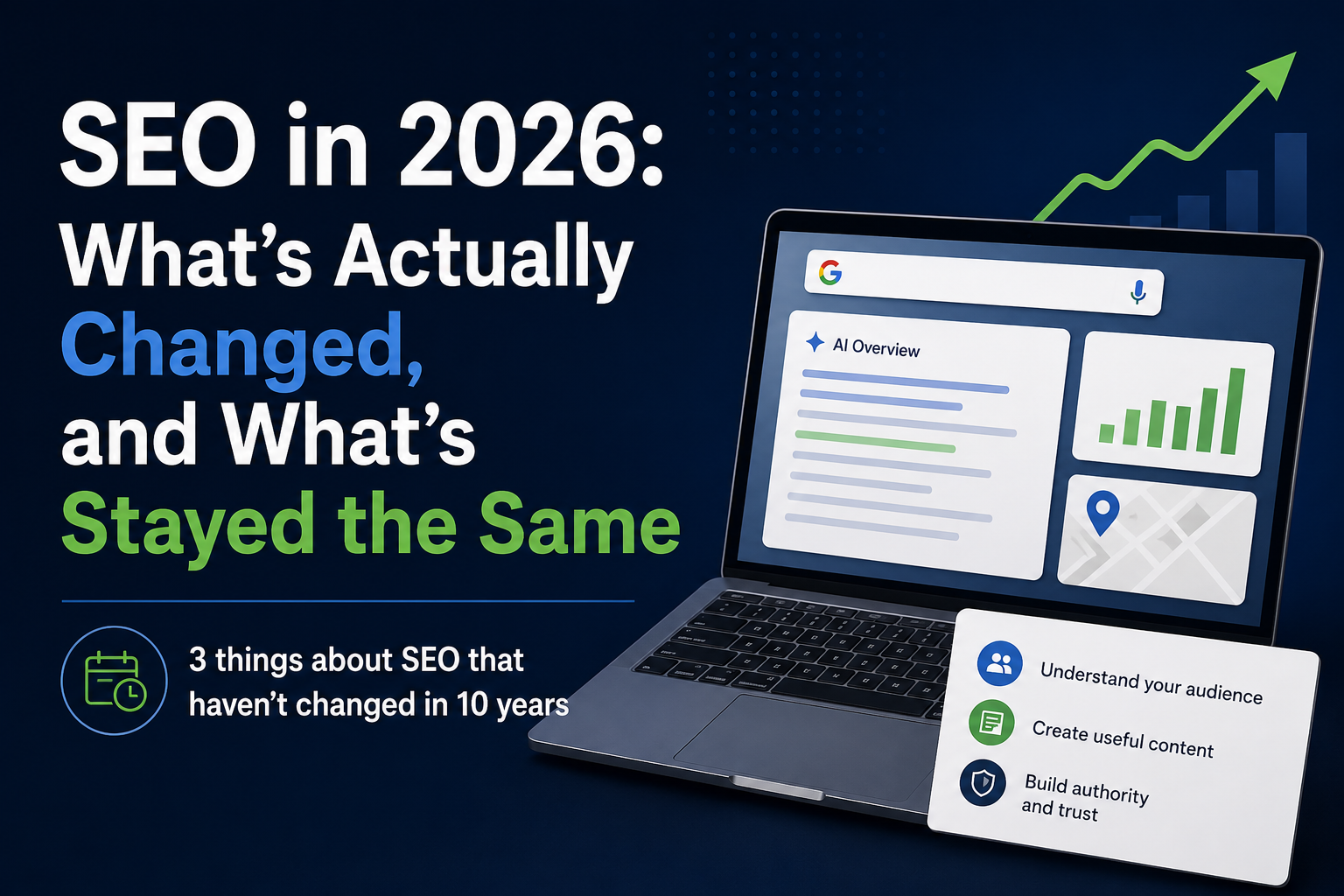
Three things about SEO that haven’t changed in ten years
Despite all the shiny new tech and trendy terminology, the foundations of solid SEO are still pretty much the same.
- You still need to understand what your customers are searching for
Good SEO starts with understanding what people are looking for.
Back ten years ago, that meant identifying the words and phrases people were typing into Google. That’s still important today – even if those searches are longer and more specific or get posed as a proper question.
Keyword research helps businesses figure out:
- What products and services people are looking for
- How customers describe their problems
- What questions crop up during the buying journey
- Whether someone’s searching for information or actually looking to buy
- Which locations, features or benefits matter most
Without doing all that research, businesses often end up building pages around internal jargon rather than the words their customers actually use.
The tools may have improved, but the principle remains the same: understand your audience before creating or optimising your website.
- Good content still wins
Search engines want to give users the best possible results. You don’t need to have a huge amount of content to make it useful, as long as it does the job of answering the question properly. A strong service page should explain what services you offer, who they are for, why you are a good choice and what they should do next.
A good article should answer a real question clearly and accurately, without burying the answer under a load of introduction or repeating the point over and over again just to hit a word count.
Before you publish a page, ask yourself:
- Does this actually answer the visitor’s question?
- Is the information crystal clear and accurate?
- Does it offer anything more useful than the competition?
- Is it easy to read and navigate?
- Does it actually help the visitor take the next step?
The idea of “people-first content” may be a new phrase, but the underlying idea of putting people first has been around for ages.
- A good online reputation still counts for a lot
Google still values a business’s online reputation, and a site with a strong reputation will always have an edge over one with a poor one. That was still true back in 2016, and it remains true to this day in 2026.
Building authority takes time and it is not an overnight sensation. There never has been a reliable quick fix to getting real lasting SEO success.
Search engines look at a whole bunch of different signals when deciding which websites deserve visibility, and that includes things like website quality, mentions on other other relevant sites, up to date business information, how your customers rate your business, and whether you have a genuine track record of expertise.
You build authority over time by consistently getting the basics right. This means:
- Publishing genuinely useful content that people will actually use
- Getting relevant links and mentions from other sites
- Keeping your business information accurate and up to date
- Making sure your website is secure and well looked after
- Showing how much experience you have
- Collecting genuine customer reviews through platforms like Google Reviews and TrustPilot
- Building a recognisable brand
Short term fixes can sometimes give you a bit of a boost, but genuine SEO success comes from doing all these things consistently over a long period of time.
Ten years ago businesses needed patience. Ten years later it is still needed.
Has SEO become more difficult?
Well, yes, in some ways it has. There are more search features, more content out there and more competition for people’s attention. Now you need to think about traditional rankings alongside local results, images, video and AI generated answers.
But the main focus hasn’t changed. To get good SEO you still need to understand who your customers are, create useful pages, keep your website in good working order and build trust over time.
The challenge is that you now have to apply those rules in a faster moving, more complicated search environment.
What should businesses be focusing on in 2026?
Rather than chasing after every new buzzword (GEO, AEO, AI SEO) or supposed ranking trick, businesses should focus on a couple of key things.
Check whether your main service and product pages are actually answering the questions your customers are asking. Make sure search engines can actually crawl, understand and index your website. Improve any pages that get visibility but do nothing for you. Publish original content that shows you’re an expert. Get your local presence and online reputation sorted. Finally, measure how well you’re doing against what really matters: business outcomes, not just rankings.
SEO in 2026 isn’t about choosing between old search and new AI.
Its about making your business easy to find, easy to understand and easy to trust – no matter where the search journey starts from.
The SEO basics still count
Search is changing fast, but that doesn’t mean you should forget about the rules that have worked for years.
AI may change how the results are presented, people may start asking longer questions and some users may get an answer straight away without even clicking on a website.
But businesses that understand their audience, write genuinely helpful content and build up genuine authority over time will still give themselves the best chance of getting noticed.
The tech may change.
The fact that you need to be relevant, useful and trustworthy does not.
Need to know how your website is doing?
At Front Page Advantage, we can help you improve your visibility through straightforward, measurable SEO.
Get in touch for a free SEO Video Health Check and we’ll show you where your website is at the moment and where you might be able to improve your rankings, traffic and enquiries.
